
Wrappers Change Access, Not Accountability
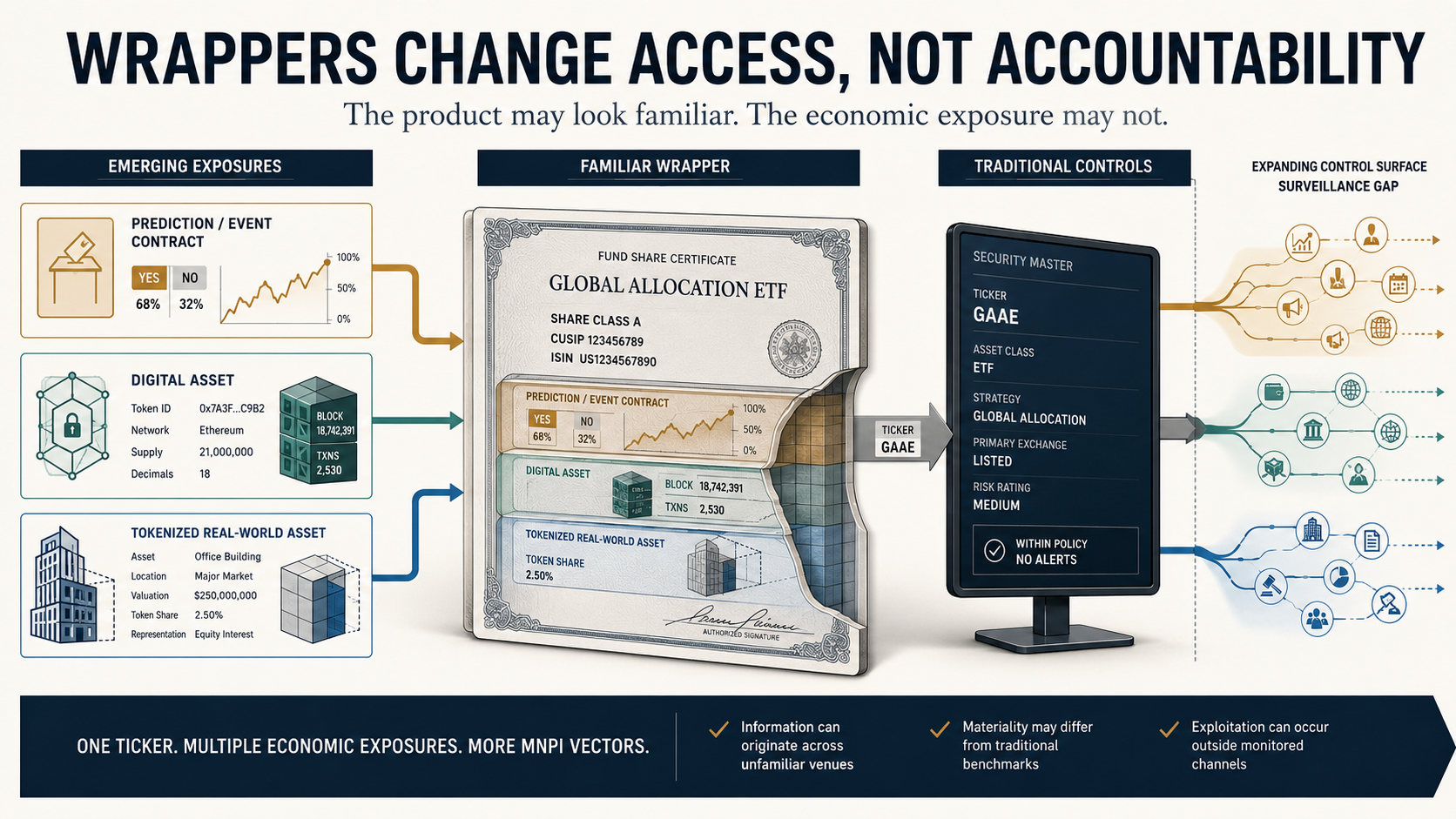
Financial innovation rarely reaches scale in its raw form. It becomes useful when someone packages it inside a structure people already understand: a token, an ETF, a managed account, a custody platform or another familiar vehicle.
That packaging is a wrapper.
Wrappers lower friction. They make unfamiliar exposures easier to buy, distribute, report and explain. They can also make the underlying risk harder to see.
In A World Beyond Securities, I argued that material, nonpublic information can now be monetized far beyond traditional securities. The Expanding Control Surface described the growing range of venues where that can happen. MNPI Vectors focused on the pathways people can use to exploit information.
Wrappers explain how those vectors move from the edges into the mainstream.
Every Successful Innovation Gets Wrapped
Consider tokenized equities. The technology and settlement mechanics may change, but the underlying instrument remains a security. The SEC has made that point explicitly.
Now consider an ETF holding digital assets, a fund built around event contracts or a structured product linked to an emerging market. The employee may be buying a familiar security through a conventional brokerage account. Economically, however, the exposure may extend well beyond the categories contemplated when the firm's policies and controls were designed.
The wrapper changes access to the risk.
That distinction matters because compliance programs often classify what an employee bought. The better question is what exposure the employee acquired, what discretion they exercised and what information could influence the outcome.
Compliance has long been built on the principle that substance matters more than form. Wrappers make that distinction increasingly important.
The legal form still matters. A wrapper may change ownership rights, liquidity or regulatory treatment. But familiar packaging should prompt deeper analysis and not a presumption that familiar controls remain sufficient.
The CFTC's recent prediction-market enforcement cases reinforce the broader principle: misuse of nonpublic information does not become acceptable simply because the instrument or venue is new.
Innovation Changes Products. Legal Obligations Remain.
Wrappers create risk at the seams between existing controls.
Product approval sees a security. Personal account dealing sees a ticker. The control room treats the underlying exposure as outside its traditional scope. Training tells employees not to trade directly in prediction markets or digital assets, while saying nothing about products that provide similar exposure indirectly.
Each process may appear reasonable on its own. Collectively, they may leave a gap.
Compliance leaders rarely control which products the business develops, which platforms employees adopt or how quickly market structure evolves. They can, however, influence whether the institution evaluates emerging products by label or by substance.
That starts with three questions: • What does the wrapper economically expose the employee to? • What types of nonpublic information could affect that exposure? • Which controls can see, evaluate and test it?
Modernization cannot mean building another bespoke rule every time innovation finds a new distribution channel. Firms need policies, data and control architecture capable of looking through the wrapper and adapting as new exposures emerge.
That requires investment. But the alternative is a control environment that appears comprehensive because it recognizes the product name while missing what the product actually does.
Markets will continue to create new wrappers. Firms cannot afford to redesign their compliance program every time they do.
The organizations that adapt best will be those whose controls are built to evaluate economic exposure - not just product labels.
Is your control framework ready for that shift?